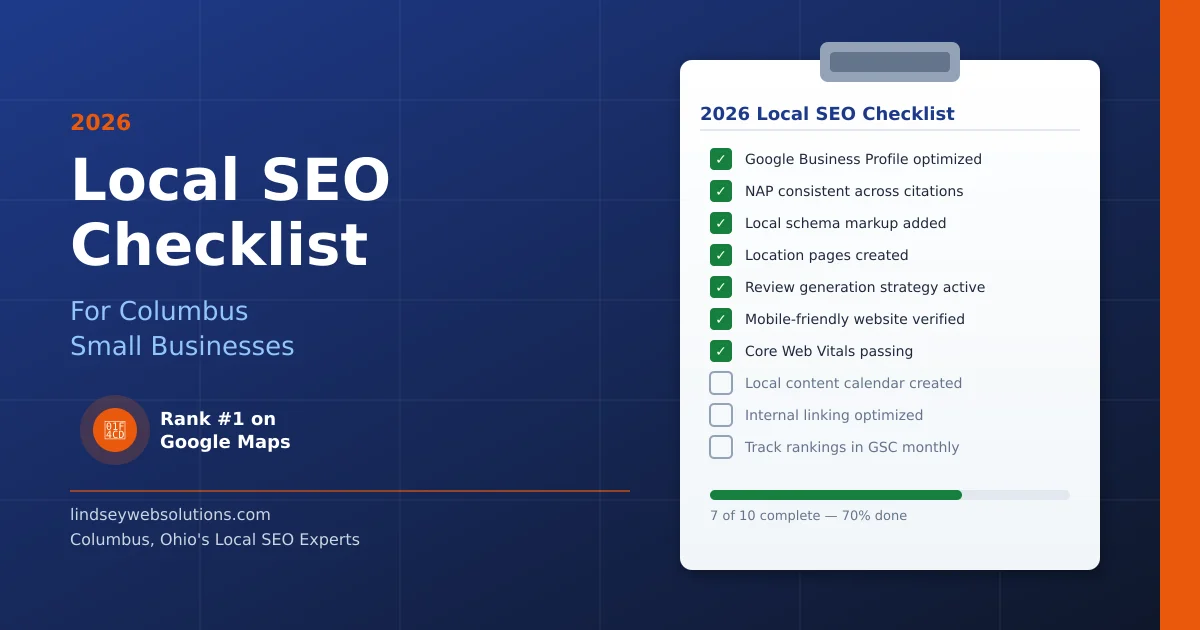
Local SEO for Small Businesses: A Practical Guide for Columbus
When a homeowner in Dublin searches “emergency plumber near me” or a student in the Short North looks up “best Italian restaurant Columbus,” Google does not pick winners at random. It serves the businesses with the strongest local SEO signals.
If you run a small business in Columbus or Central Ohio, local SEO is the difference between the phone ringing and silence. The good news? You do not need a corporate marketing budget to compete. You need the right foundation, consistent effort, and realistic expectations.
At Lindsey Web Solutions, we help Columbus-area small businesses climb local rankings with transparent pricing and no long-term contracts. Request a free local SEO review and we will show you exactly where your business stands today.
If you want quick wins you can implement this week, see our earlier guide to local SEO tips for Columbus small businesses. For a full picture of what web design and SEO services cost in Central Ohio, check out our Columbus website pricing breakdown and our complete Columbus web design guide.
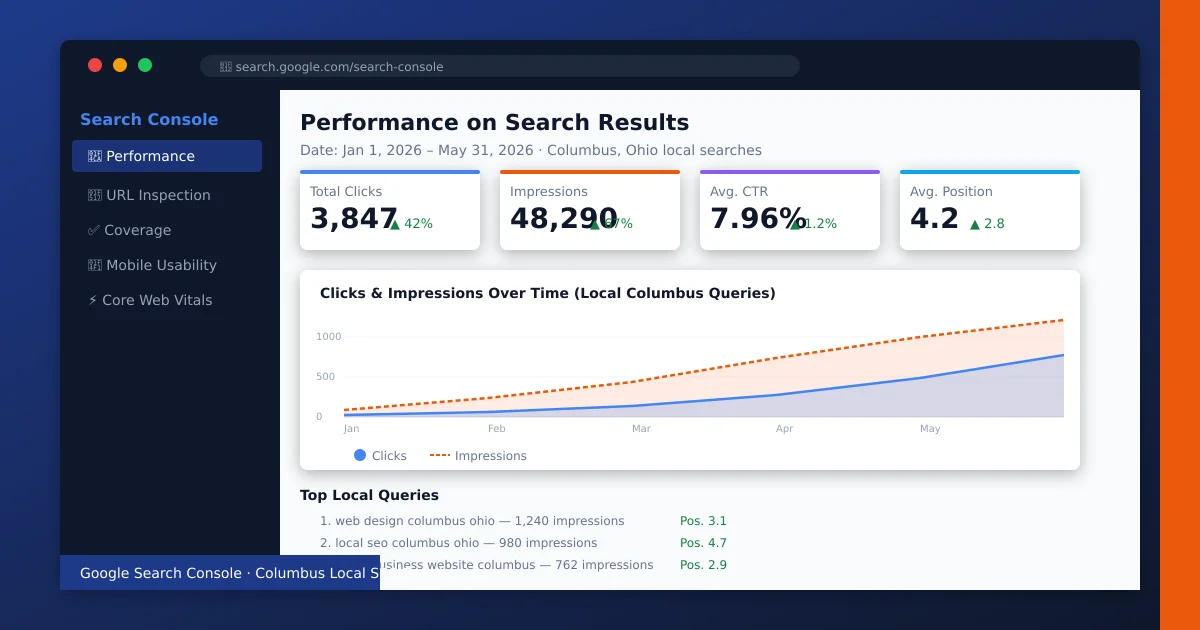
What Is Local SEO (And Why It Matters More Than Ever)
Local SEO is the practice of optimizing your online presence so you appear in location-based search results. That includes the Google local map pack (the three map listings at the top of search), Google Business Profile, and localized organic results.
Here is why it matters for Columbus small businesses:
- 46% of all Google searches include local intent, according to Search Engine Journal.
- 76% of people who search for something nearby visit a business within a day, per Google.
- 28% of local searches result in a purchase within 24 hours.
In a metro of over 2.2 million people, local SEO is not a nice-to-have. It is how customers find you before they find your competitor.
Local SEO is different from national SEO. A dental practice in Westerville is not trying to rank for “best dentist in America.” It wants to rank for “dentist near me” when someone searches from Polaris Parkway. That requires a completely different strategy.
The 4 Pillars of Local SEO
Think of local SEO as a table with four legs. Remove one, and the whole thing wobbles.
1. Google Business Profile Optimization
Your Google Business Profile (GBP) is the single most important asset for local search. It powers the map pack, local finder results, and the knowledge panel that appears when someone searches your business name.
Yet many Columbus small businesses claim their listing and never touch it again. That is leaving money on the table.
Action items:
- Verify ownership and choose the most accurate primary category
- Write a keyword-rich description mentioning Columbus and your services
- Add your exact NAP (Name, Address, Phone) and match it to your website exactly
- Upload high-quality photos of your storefront, team, products, and completed work
- Select relevant secondary categories
- Post weekly updates using the GBP Posts feature
- Add your service areas if you travel to customers
Businesses with photos on their GBP receive 42% more requests for directions and 35% more click-throughs to their website.
2. NAP Consistency Across the Web
NAP stands for Name, Address, Phone number. Google cross-references your NAP across dozens of directories to confirm you are a legitimate, established business.
Even small differences hurt. “St.” versus “Street” or a missing suite number can dilute your rankings.
Critical citation sources for Columbus businesses:
- Google Business Profile
- Your website (footer on every page)
- Yelp, BBB, Angi
- Facebook Business Page
- Columbus Chamber of Commerce
- Industry-specific directories (Healthgrades for medical, Avvo for legal)
Pro tip: Google your phone number and update any incorrect listings you find.
3. Reviews and Reputation Management
Reviews are a ranking factor, a conversion factor, and a trust factor. The top-three map listings typically have more reviews and higher ratings than the businesses below them.
Best practices:
- Ask happy customers for reviews within 24 hours of service
- Send a direct Google review link via text or email
- Respond to every review within 48 hours
- Never buy fake reviews
A 2024 BrightLocal survey found that 75% of consumers always or regularly read reviews when browsing for local businesses. If your competitor has 80 reviews and you have 8, guess who gets the call?
4. On-Page Location Signals
Your website needs to tell Google where you are and who you serve.
On-page essentials:
- Location-specific title tags and meta descriptions
- Embedded Google Map on your contact page
- LocalBusiness schema markup with name, address, phone, hours, and geo-coordinates
- Dedicated service-area pages for each suburb you serve - see our guides for Westerville, Gahanna, New Albany, Grove City, Worthington, Powell, and more
- Locally relevant blog content
One Columbus contractor added service-area pages for Hilliard, Powell, and Dublin and saw a 34% increase in contact form submissions within 90 days.
How Long Does Local SEO Take?
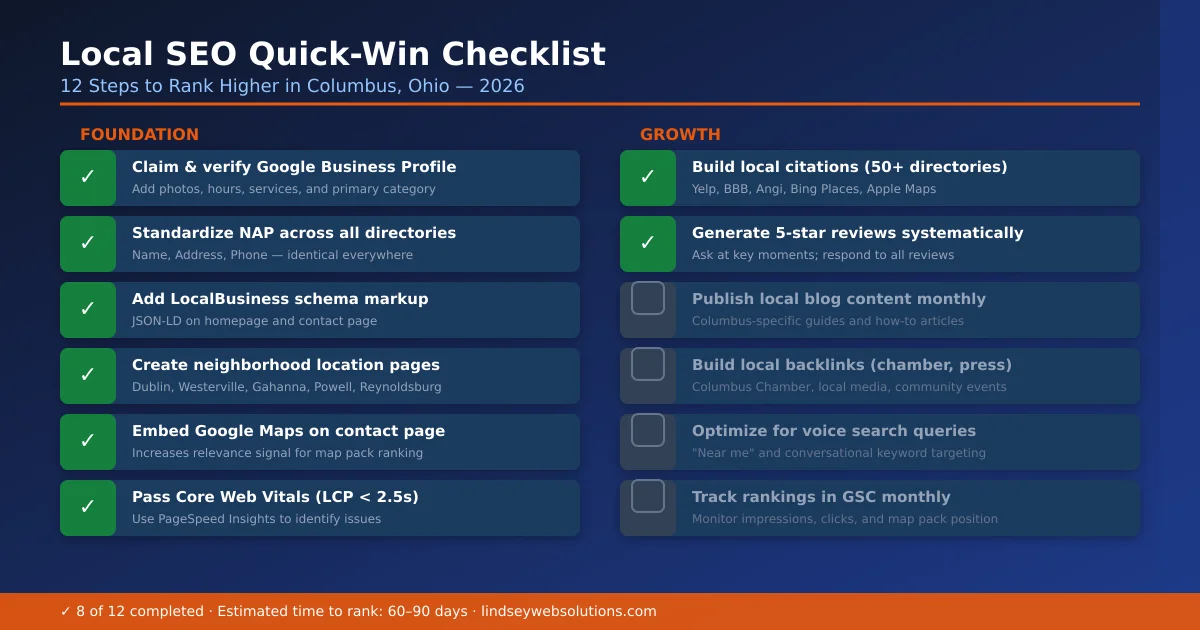
This is the most common question we hear from Columbus business owners. Here is an honest timeline based on real results:
| Milestone | Typical Timeline | What Happens |
|---|---|---|
| GBP optimization complete | Week 1–2 | Profile is fully filled out, photos uploaded, first posts published |
| Initial ranking movement | 4–8 weeks | Google has crawled your changes; you may see jumps in map pack position |
| Meaningful traffic growth | 3–6 months | Content and citations compound; you start seeing consistent organic calls and forms |
| Compounding gains | 6–12 months | Your site ranks for keywords you did not explicitly target; domain authority grows |
Local SEO often moves faster than national SEO because the competition is narrower. A new Columbus restaurant can start appearing in “restaurants near me” searches within 4–6 weeks of proper GBP optimization. A brand-new website in a competitive niche may need the full 3–6 months.
What Local SEO Costs in Columbus
LWS local SEO runs $500–2,000/mo, month-to-month. Includes GBP optimization, citation building, review management, and monthly reports.
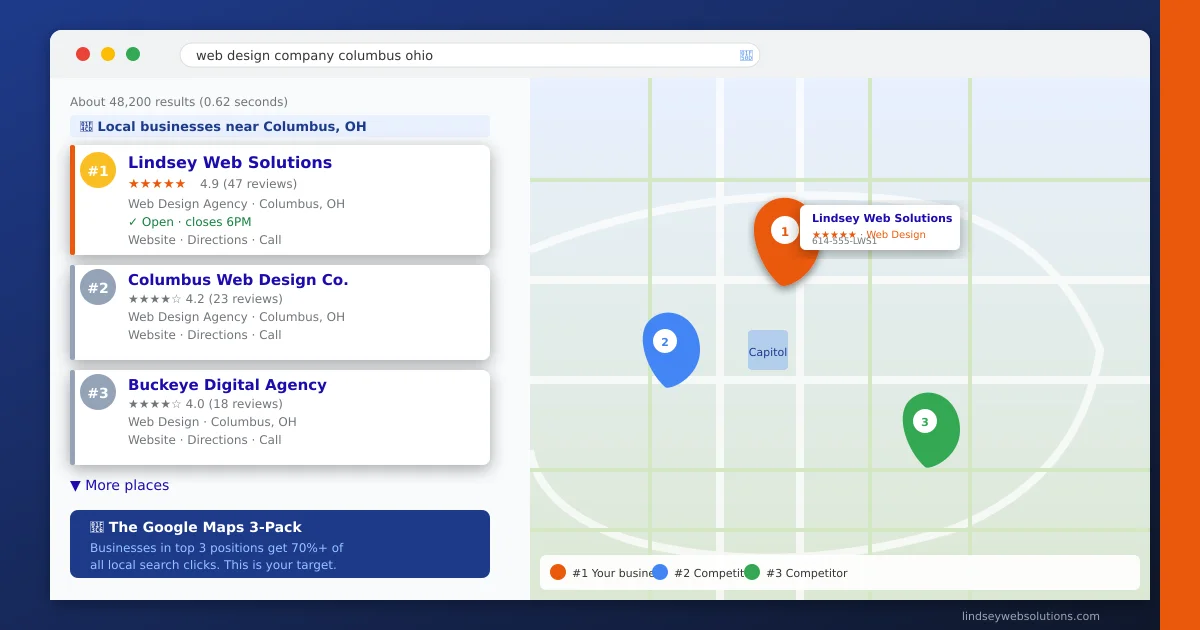
5 Local SEO Mistakes Columbus Businesses Make
Common pitfalls: duplicate GBP listings, keyword stuffing, ignoring reviews, no location pages, and missing schema markup.
How to Track Local SEO Results
Key metrics: GBP performance, ranking positions, organic traffic via GA4, and conversion events. Calculate cost per lead monthly.
Local SEO and a strong website go hand in hand. Before any optimization effort, make sure your site is built to convert. Browse our full web design and digital marketing services to see how we help Columbus businesses build fast, SEO-ready websites that turn local searchers into paying customers.
Ready to Get Found in Columbus?
Local SEO is not a one-time project — it is an ongoing practice. Columbus businesses that rank consistently optimize their GBP, earn reviews, create local content, and maintain fast websites.
Book a free local SEO review with Lindsey Web Solutions today.